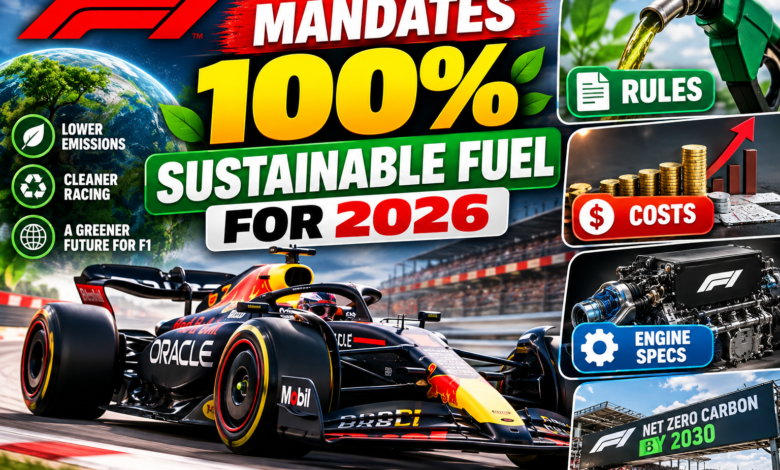
Formula 1 has officially confirmed that every car on the grid will run on F1 100 sustainable fuel 2026 season, ending the sport’s reliance on conventional fossil gasoline. Marking the most aggressive environmental step in F1 history, this technical overhaul supports the FIA’s broader commitment to achieving Net-Zero carbon emissions by 2030.
Under the new regulations, all 10 teams must certify their fuel composition by March 15, 2026, ahead of the season-opening Australian Grand Prix.
Key Highlights of F1 100 sustainable fuel 2026 Transition
- 100% Non-Fossil Blend: The FIA-approved drop-in fuel contains zero crude-oil hydrocarbons, utilizing non-food biomass, municipal waste, and direct air carbon capture (e-fuels).
- Power Unit Recalibration: Engine manufacturers are redesigning combustion chambers, fuel injectors, and exhaust systems to handle higher viscosity and altered combustion parameters.
- $45 Million Budget Adjustment: Development outlays are absorbed under a revised FIA cost cap that includes a dedicated green-tech allowance.
- Strict FIA Audits: Real-time trackside spectrometer checks will enforce a 0.5% tolerance limit, with non-compliance triggering a $2 million fine and grid penalties.
Technical Shift: Engineering Carbon-Neutral Performance
Developed in partnership with major energy suppliers and biotech research facilities, the advanced sustainable fuel matches the energy density of conventional 2025 race fuel. Because the process captures as much carbon dioxide during production as it emits when burned, the fuel eliminates F1’s primary source of direct trackside emissions.
Engine Recalibration Across Power Unit Divisions
Leading manufacturers—including Mercedes, Ferrari, Red Bull Powertrains, and Honda—have modified their 1.6-liter V6 turbo-hybrid architectures:
- High-Pressure Fuel Systems: Upgraded fuel pumps now operate at higher pressures to process the new fuel’s increased viscosity.
- Combustion Chamber Upgrades: Reinforced pistons and altered thermal mapping optimize torque delivery despite cooler exhaust gas output.
- Weight Offsets: While revised engine hardware adds roughly 150 kg, lighter chassis dimensions under the 2026 active aerodynamic package compensate for the difference.
Performance Impact: Pre-Season Testing Analysis
Data from early pre-season testing at the Bahrain International Circuit shows a minor drop in peak output—averaging 1,500 kW compared to 1,540 kW in 2025. However, lap times remain highly competitive due to reduced drag and updated aerodynamic setups.
| Metric | 2025 Conventional Fuel | 2026 Sustainable Fuel | Impact |
|---|---|---|---|
| Average Peak Power | ~1,540 kW | ~1,500 kW | ~2.5% decrease |
| Top Speed (Bahrain) | 336 km/h | 335 km/h | Negligible change |
| Lap Time Delta | Benchmark | +0.8 seconds | Offset by Active Aero |
| Soot / Tire Wear | Standard | -12% Soot Output | Extended tire life |
Strategic Team Responses and Commercial Alignment
Top teams have adapted their operational strategies to maximize the new fuel chemistry:
- Ferrari: Prioritized internal component longevity, deploying reinforced piston walls that extend power unit life by 15%.
- McLaren: Optimized ECU software mapping to alternate between lean and rich mixtures during high cornering loads.
- Red Bull & Mercedes: Leveraged reduced soot output to manage thermal degradation and improve stint consistency on race day.
Sponsor Re-Alignment and Commercial Growth
The sustainable fuel mandate has attracted new luxury and ESG-focused sponsors like Ørsted and Patagonia. Major oil partners—including Shell, ExxonMobil, and Aramco—have rebranded their motorsport divisions to highlight renewable technology development, pledging over $200 million in joint research.
Compliance Deadlines and the 2026 Season Roadmap
The FIA has outlined strict compliance benchmarks ahead of the season opener:
- March 15, 2026: Final deadline for all teams to submit fuel-mix certification.
- Australian Grand Prix: Inaugural race featuring a mandatory “green-lap” demonstration to showcase live bio-fuel data metrics.
- 2028 Future Vision: The FIA plans to utilize insights from the 2026 fuel rollout to introduce a 100% electric support series framework.
Conclusion
The transition to 100% sustainable fuel in 2026 represents a major technological leap for Formula 1. By proving that drop-in carbon-neutral fuels can power high-performance hybrid engines without compromising racing quality, F1 continues to serve as an R&D testbed for global automotive innovation.
About The Author