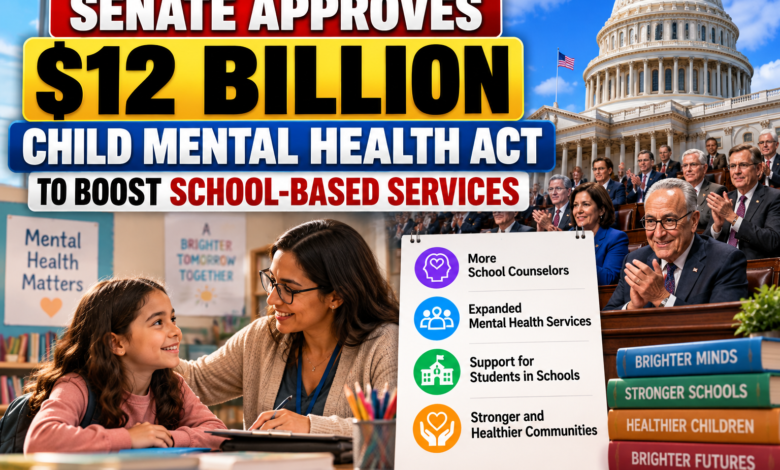
Senate Approves $12 Billion Child Mental Health Act to Boost School-Based Services
In a decisive 62‑35 vote, the U.S. Senate approved the bipartisan Child Mental Health Act, authorizing a landmark $12 billion package over five years to expand school-based mental health services and establish a real-time national data hub for pediatric crisis tracking. Championed by Senators Maria Cruz (D‑CA) and James Holt (R‑TX), the legislation addresses a severe nationwide shortage of pediatric counselors and crisis resources.
Implementation is set to begin in fiscal year 2027, requiring states to submit detailed rollout plans within 180 days of enactment.
Key Takeaways of the Child Mental Health Act
-
$12 Billion Total Funding: Authorizes $8 billion directly for school counseling and crisis-intervention teams over five years.
-
Counselor-to-Student Ratios: Mandates public school districts with over 5,000 students to hire at least one counselor for every 250 students.
-
National HHS Data Hub: Establishes a real-time cloud platform under FISMA standards to track emergency visits and youth crisis trends.
-
Strict State Deadlines: States must file implementation strategies within 180 days, with first reports scheduled for release in late 2027.
Funding Mechanics and Allocation Priorities
The Child Mental Health Act distributes funds through a targeted formula that evaluates student enrollment numbers, regional poverty rates, and existing mental health infrastructure.
Roughly 60% of the $8 billion dedicated to educational institutions directly funds full-time licensed counselors, while the remaining 40% supports mobile crisis response units, tele-health platforms, and professional development.
School Counseling Expansion
To improve access in classrooms, school districts receiving federal grants must adjust staffing levels. The bill introduces a dedicated grant program enabling rural school districts to partner with regional health centers, ensuring tele-counseling resources reach remote students.
Crisis-Intervention Teams
Designated mobile crisis units funded by the act will consist of a licensed therapist, a social worker, and a school administrator trained in suicide prevention protocols. Funding covers 24-hour on-call services, mobile response vehicles, and direct coordination with local Emergency Medical Services (EMS).
National Data Hub: Real-Time Insight Into Youth Crises
As a core requirement of the Child Mental Health Act, the Department of Health and Human Services (HHS) will deploy a secure, cloud-based platform aggregating de-identified data from emergency rooms, school incident reports, and primary care visits.
By late 2027, this national platform will deliver monthly analytical dashboards to state health officials, identifying localized spikes in self-harm, substance misuse, or severe anxiety incidents.
Privacy Safeguards and Oversight
All data collected under the Child Mental Health Act will be stripped of personal identifiers in strict compliance with Federal Information Security Management Act (FISMA) standards. An independent oversight panel—comprising child advocacy experts, mental health professionals, and privacy attorneys—will audit system access logs on a quarterly basis.
Political Landscape and Opposition Arguments
While the bill passed with strong bipartisan support, the legislative debate highlighted differing perspectives among education officials:
-
Bipartisan Coalition (62 Votes): Proponents emphasized that rising rates of pediatric mental health emergencies require structural intervention rather than short-term fixes.
-
Workforce Strain Concerns (35 Votes): Opponents, led by representatives from school board associations, argued that rigid counselor-to-student ratio mandates could penalize smaller or rural districts facing localized staffing shortages.
To address these concerns, lawmakers added flexibility provisions allowing rural communities to meet compliance through regional health partnerships and remote tele-health solutions.
Implementation Timeline for the Child Mental Health Act
To track compliance across state education departments and health agencies, federal authorities have established the following rollout schedule:
| Target Deadline | Mandatory Action Required under Child Mental Health Act |
| March 1, 2027 | HHS issues official implementation guidelines to all states. |
| September 2027 | Release of the first quarterly national youth crisis data reports. |
| December 2027 | Final deadline for school districts to achieve required counselor staffing ratios. |
Districts that meet or exceed staffing benchmarks by the December 2027 cutoff will become eligible for a share of an additional $500 million supplemental grant pool dedicated to after-school art therapy and mindfulness programs.
Conclusion
The passage of the Child Mental Health Act marks a significant structural investment in school-based healthcare infrastructure. By pairing direct counseling funds with real-time data tracking and crisis intervention teams, the law establishes a new federal framework for youth mental health support across the country.
About The Author